
Posts Tagged ‘obedience’

Mighty Weapons

Sunday, July 19th, 2009

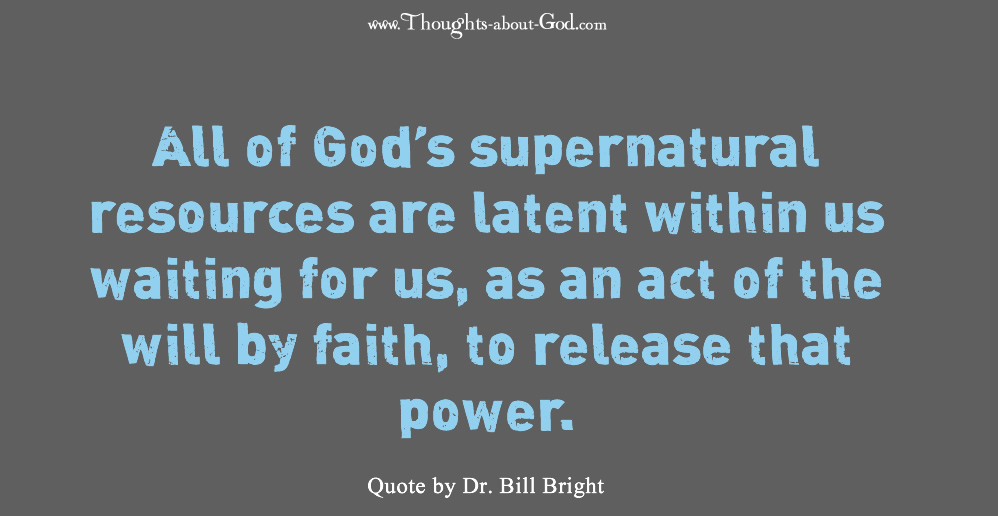
by Dr. Bill Bright
______________________________________________________________

“I use God’s mighty weapons, not those made by men, to knock down the devil’s strongholds. These weapons can break down every proud argument against God and every wall that can be built to keep men from finding Him. With these weapons I can capture rebels and bring them back to God, and change them into men whose hearts’ desire is obedience to Christ? 2 Corinthians 10:4,5

Joe came to share with me how his leader in a particular Christian organization had been most unfair to him. He was being relieved of his responsibilities and replaced by another who, in his opinion, was not nearly as well qualified. As we talked it became apparent that Satan easily could sabotage the ministry.

After listening to Joe’s grievances for some time, seeking to know the truth of the matter, I inquired as to his walk with God. "Is there any sin in your life? Do you know for sure that you’re filled with the Holy Spirit?" Then I brought the other party into private conference and inquired as to his relationship with God. "Is there any sin in your life? Do you know for sure that you’re filled with the Holy Spirit?" Both assured me that they were filled with the Spirit and that they genuinely desired to know and do the will of God. I was convinced that they were both sincere.

How then could two men without sin in their lives and who claimed to be filled with the Holy Spirit be at such odds? I sought further truth. In the meantime, we brought to bear the weapons of prayer and the Word of God. God says that when brothers are at odds we should claim in prayer the release of His supernatural wisdom to resolve the matter, and, finally, claim by faith that Satan will be routed, that all of his influence will be overcome.

The counseling required several hours. I talked to one individual, then the other, then both of them together. Finally, we were on our knees praising God and then embracing each other, and the men genuinely felt that their relationship with each other and with the Lord had been fully restored. Satan had lost another battle. Another miracle had happened. Another tragedy had been averted and the Body of Christ had been spared another scandal.

What are those weapons? A holy life, the Holy Spirit, prayer, the Word of God, faith, truth - these are the weapons of God for supernatural warfare. Learn how to use them for His glory.

Bible reading: Ephesians 6:10-17

Today's action point: Whenever Satan attacks me, or I observe conflicts in the Body of Christ due to his influence, I will seek to defeat him by using God’s mighty weapons and will teach other Christians how to apply them in times of spiritual battle.

You can comment on this devotional online at:
http://thoughts-about-god.com/blog/2009/07/19/bb_weapons/

____________________________________________________________
Christian Wallpaper for your computer. Get the new wallpaper at:
http://www.thoughts-about-god.com/wallpaper/
____________________________________________________________

First

Wednesday, July 1st, 2009

by Skip Moen, D. Phil.
_____________________________________________________________________________________

“And He said, “Take your son, your favored one, Isaac, whom you love, and go
to the land of Moriah, and offer him th
ere
� Genesis 22:2

Love – There’s a first time for everything. First times are usually quite significant, especially when the occurrences are in the Bible. For example, the first time we encounter the word ‘ezer (translated “helper�), we learn something incredibly important about women.  In this verse, we encounter the word ‘ahav for the first time. Oh, you need to know what ‘ahav means. This is the Hebrew word for love.

Do you find this a bit curious? After all, here we are in the middle of Genesis. We have already covered the creation, Adam and Eve, Noah, Abraham’s call and the birth of Isaac, but not once is the word ‘ahav used in any of those stories. If we were writing the book of Genesis from our John 3:16 evangelical perspective, we would probably start with this word. “In the beginning, God loved,� is probably how we would open the text. But the Hebrew Scriptures reserve this word until God challenges Abraham to sacrifice his only son. That’s when ‘ahav becomes the only word significant enough to capture the thought. There must be a reason for this linguistic economy. What makes this particular story so different that it requires the introduction of this very special word?

If you connected this story to the sacrifice of another Son, then you’re in the right ball park. ‘ahav describes a relationship between Abraham and Isaac that reflects another relationship, one that becomes the center point of all human existence. The Father and Son share a special destiny, and a special bond. And the love is not one-way. Isaac has to love Abraham enough to willingly lay down his life in obedience. Certainly Isaac could have easily overpowered Abraham and saved himself. But there is not a single hint of this in Scripture. Isaac loves his father. In Hebrew, that love is displayed by trusting him, no matter what the circumstances might seem to indicate. Does Isaac anticipate something is wrong? Of course. “Where is the sheep for the offering?� Does it prevent Isaac from walking alongside his father to the place of sacrifice? Not at all. Isaac obeys. That’s love.

Does Abraham love Isaac? How could a man who loves his son be willing to sacrifice him? But the text tells us that Abraham does love Isaac. In fact, he loves Isaac in a way that is unparalleled in any previous relationship between human beings. This is the first time ‘ahav occurs. Abraham loves Isaac so much that he is willing to trust his son’s fate to the God he has known for a century. Abraham withholds nothing. That is also love. And, not coincidentally, all these factors play a part in the love of the Father for the Son as the story concludes 3000 years later.

The Scriptures are God’s living word. They are deliberate words. When they don’t follow the patterns we would expect, we need to pay very close attention. There is usually something hidden from view that we need to know.

You can comment on this devotional online at:
http://thoughts-about-god.com/blog/2009/07/01/sm_first/

Desiring God

Thursday, March 26th, 2009

by Skip Moen, PhD
__________________________________________________________

“Thy will be done.�  Matthew 6:10

j04348591Will - “But how do I know what God’s will is?�  Have you struggled with that question?  I have - more often than not.  I long to do His will, but knowing what He wants in any of the various gray areas of my life is not so easy to determine.  Sure, I have to book of instructions (the Torah), but I am hard pressed to find anything there about retirement plans, career moves, home schooling or automobile choices.  Nevertheless, I pray, “Your will be done,� as if I knew what it really was.  And, since I am often quite confused about the correct choice, I add the cover phrase “if it’s Your will, Lord,� to most of my prayers.

That doesn’t seem to be what Yeshua had in mind.  He doesn’t appear to vacillate over direction.  In fact, there isn’t even a hint of doubt in this part of the model prayer.  Yeshua prays boldly for the exercise of the Father’s will.  Or so it seems.  Let’s take a look.

The Greek word thelema is very common in classical Greek, but it is surprisingly rare in the New Testament.  When we look at its Hebrew equivalent (rason), we find something even more interesting.  Rason is not about rational decisions like the Greek word.  It is about passionately birthed desire.  In other words, Yeshua is not talking about all the choices that make up God’s purpose and direction.  He is talking about the joy, delight and passion that belong to the character of what God does.  Did you get that?  It’s hard to re-think in a world that is saturated with the notion that will is about cognition.  We split emotion and will, but Hebrew is a lot fuzzier.  To proclaim God’s will is to announce my delight, joy and passion for His display.  It is to endorse His glorification in action.  Furthermore, this phrase commits me to His holiness because the only thing God must do is exhibit His holy character.  What God does is holy.  Therefore, when I pray “Your will be done,� I am asking that He manifest Himself as holy regardless of my agenda or interpretation.  And, of course, this is exactly what God already does.  So, my petition is really a declaration of His inscrutable righteousness.  Speaking blessings upon His will is, at the same time, my commitment to contentment.  I declare that I am content with His purposes.  I long for His holiness to be manifest.  I delight in seeing it.

Sounds good, doesn’t it?  And it is good, except that it immediately confronts us with our own resistance to His will.  How can we pray for God’s holiness to be manifest and for contentment with this manifestation and then immediately ask Him to explain what He requires of us.  You see, the will of God is not found in peaceful co-existence.  It is found in obedience!  God has already revealed His moral will.  It’s called the Torah.  To pray for His will to be the passionate delight of my life and, at the same time, refuse to be obedient to the manifestation of His instructions is not only self-contradiction, it is sin.  This has nothing to do with His freely given grace.  This has everything to do with delighting in Him.  The disciples knew exactly what Yeshua meant.  Do we?

One additional clarification must be made.  Contentment is not passive.  It is self-surrender in the active pursuit of the eschatological horizon of the coming government of God.  OK, maybe that’s a bit too theological.  What I’m saying is the when I am content with God’s purposes, I do not sit idly by and wait for Him to do everything.  My declaration is a statement of my active obedience and passionate decision to do whatever is required of me to fulfill His purposes within His Kingdom.  My will is subsumed in His will.  I do the Kingdom because I live the Kingdom.  And I never rest until I am fully content in Him.

You can comment on this devotional online at:
http://thoughts-about-god.com/blog/2009/03/26/sm_desiring-god/
Not to be reprinted without permission